


Search results for "9780241471029"
Items in stock - 4 working days delivery time

Midnight Library
THE SUNDAY TIMES NUMBER ONE BESTSELLING WORLDWIDE PHENOMENON READERS' MOST LOVED BOOK OF 2021WINNER OF THE GOODREADS CHOICE AWARD FOR FICTION'BEAUTIFUL' Jodi Picoult, 'UPLIFTING' i, 'BRILLIANT' Daily Mail, 'AMAZING' Joanna Cannon, 'ABSORBING' New York Times, 'THOUGHT-PROVOKING' IndependentNora's life has been going from bad to worse. Then at the stroke of midnight on her last day on earth she finds herself transported to a library. There she is given the chance to undo her regrets and try out each of the other lives she might have lived. Which raises the ultimate question: with infinite choices, what is the best way to live?
R 315.00
1929: The Inside Story of The Greatest Crash in Wall Street History
From the bestselling author of Too Big to Fail, “the definitive history of the 2008 banking crisis,”* comes a spellbinding narrative of the most infamous stock market crash in history. With the depth of a classic history and the drama of a thriller, 1929 unravels the greed, blind optimism, and folly that led to an era-defining collapse—one with ripple effects that still shape our society todayIn 1929, the world watched in shock as the unstoppable Wall Street bull market went into a freefall, wiping out fortunes and igniting a depression that would reshape a generation. But behind the flashing ticker tapes and panicked traders, another drama unfolded—one of visionaries and fraudsters, titans and dreamers, euphoria and ruin. With unparalleled access to historical records and newly uncovered documents, New York Times bestselling author Andrew Ross Sorkin takes readers inside the chaos of the crash, behind the scenes of a raging battle between Wall Street and Washington and the larger-than-life characters whose ambition and naivety in an endless boom led to wreckage. The dizzying highs and brutal lows of this era eerily mirror today’s world—where markets soar, political tensions mount, and the fight over financial influence plays out once again. This is not just a story about money. 1929 is a tale of power, psychology, and the seductive illusion that “this time is different.” It’s about disregarded alarm bells, financiers who fell from grace, and skeptics who saw the crash coming—only to be dismissed until it was too late. Hailed as a landmark book, Too Big to Fail reimagined how financial crises are told. Now, with 1929, Sorkin delivers an immersive, electrifying account of the most pivotal market collapse of all time—with lessons that remain as urgent as ever. More than just a history, 1929 is a crucial blueprint for understanding the cycles of speculation, the forces that drive financial upheaval, and the warning signs we ignore at our peril. *The Atlantic Monthly
R 885.00
Items we need to order for you
R 582.00
R 250.00
R 765.00
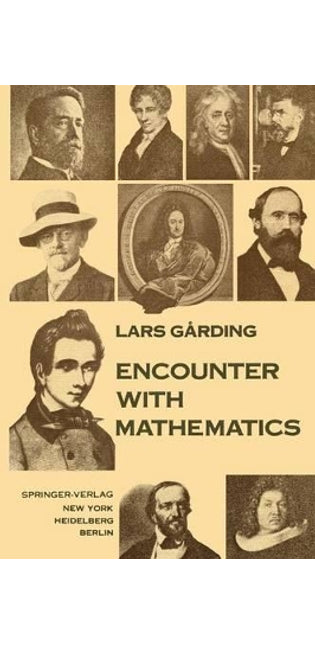
Encounter with Mathematics
Trying to make mathematics understandable to the general public is a very difficult task. The writer has to take into account that his reader has very little patience with unfamiliar concepts and intricate logic and this means that large parts of mathematics are out of bounds. When planning this book, I set myself an easier goal. I wrote it for those who already know some mathematics, in particular those who study the subject the first year after high school. Its purpose is to provide a historical, scientific, and cultural frame for the parts of mathematics that meet the beginning student. Nine chapters ranging from number theory to applications are devoted to this program. Each one starts with a historical introduction, continues with a tight but complete account of some basic facts and proceeds to look at the present state of affairs including, if possible, some recent piece of research. Most of them end with one or two passages from historical mathematical papers, translated into English and edited so as to be understandable. Sometimes the reader is referred back to earlier parts of the text, but the various chapters are to a large extent independent of each other. A reader who gets stuck in the middle of a chapter can still read large parts of the others. It should be said, however, that the book is not meant to be read straight through.
R 2,244.00
R 1,097.00
R 512.00
R 601.00
Many Rational Points
2 Triangle Groups: An Introduction 279 3 Elementary Shimura Curves 281 4 Examples of Shimura Curves 282 5 Congruence Zeta Functions 283 6 Diophantine Properties of Shimura Curves 284 7 Klein Quartic 285 8 Supersingular Points 289 Towers of Elkies 9 289 7. CRYPTOGRAPHY AND APPLICATIONS 291 1 Introduction 291 Discrete Logarithm Problem 2 291 Curves for Public-Key Cryptosystems 3 295 Hyperelliptic Curve Cryptosystems 4 297 CM-Method 5 299 6 Cryptographic Exponent 300 7 Constructive Descent 302 8 Gaudry and Harley Algorithm 306 9 Picard Jacobians 307 Drinfeld Module Based Public Key Cryptosystems 10 308 11 Drinfeld Modules and One Way Functions 308 12 Shimura's Map 309 13 Modular Jacobians of Genus 2 Curves 310 Modular Jacobian Surfaces 14 312 15 Modular Curves of Genus Two 313 16 Hecke Operators 314 8. REFERENCES 317 345 Index Xll Preface The history of counting points on curves over finite fields is very ex- tensive, starting with the work of Gauss in 1801 and continuing with the work of Artin, Schmidt, Hasse and Weil in their study of curves and the related zeta functions Zx(t), where m Zx(t) = exp (2: N t ) m m 2': 1 m with N = #X(F qm).If X is a curve of genus g, Weil's conjectures m state that L(t) Zx(t) = (1 - t)(l - qt) where L(t) = rr~!l (1 - O'.
R 4,115.00
R 830.00
R 493.00
Mastermind
No fictional character is more renowned for his extraordinary powers of mind than Sherlock Holmes. But what exactly is it that sets him apart as a detective of the highest order, and can we harness his genius? In Mastermind, psychologist Maria Konnikova shows us how we can all channel Holmes's famous powers of deduction, observation, memory and imagination. Drawing on the latest research in neuroscience and psychology, Konnikova unpacks the mental strategies that can help sharpen our perceptions, improve our logic and enhance our creative powers. Mastermind is a remarkable and entertaining guide to upgrading the mind.
R 351.00
R 686.00
R 437.00
R 233.00
R 405.00
Numerische Methoden
Da seit dem Erscheinen der ersten Auflage mehr als ein Dutzend Jahre vergangen sind, machte sich eine gründliche Überarbeitung des Bandes nötig. Das Kapitel "Gleichungssy steme" wurde erweitert durch Ausführungen zur Lösung von tridiagonalen linearen Glei chungssystemen; die Ausführungen zur Interpolation wurden stark verändert; der Ab schnitt "Anfangswertaufgaben bei gewöhnlichen Differentialgleichungen" wurde völlig neu verfaßt. Die moderne Entwicklung und der weitverbreitete Einsatz von elektronischen Rechen anlagen (Computern) üben starken Einfluß auf die numerische Mathematik aus. Zwischen numerischer Mathematik und Informatik haben sich enge Wechselbeziehungen entwik kelt. Die moderne Rechentechnik hat neue Maßstäbe in der Wertung und Einschätzung numerischer Verfahren gebracht, Einfluß auf die theoretische Weiterentwicklung der nu merischen Mathematik genommen, in großem Umfang zur Weiter-und Neuentwicklung numerischer Algorithmen geführt und es ermöglicht, immer größere und komplexere Pro bleme in Angriff zu nehmen. Dieser Entwicklung wurde bei der Überarbeitung dieses Bandes zum Beispiel bei der Auswahl der Verfahren und durch die relativ gründliche Be handlung von Stabilitätsfragen Rechnung getragen. Die Autoren versuchen der legitimen Forderung nach Querverbindungen zur Informatik auch dadurch nachzukommen, daß an das Ende jedes Kapitels ein Abschnitt "Programmierung und Software" angefügt wurde. Für drei ausgewählte grundlegende Verfahren werden Programmablaufpläne angegeben. Die Angabe von vollständigen Programmen oder von Programmablaufplänen für jedes Verfahren würde den Rahmen und den Umfang dieses Bandes sprengen und ist der Spe zialliteratur vorbehalten; ein Verzeichnis ausgewählter, weiterführender Spezialliteratur ist dem eigentlichen Literaturverzeichnis beigefügt.
R 1,683.00
Book of Numbers
"...the great feature of the book is that anyone can read it without excessive head scratching...You'll find plenty here to keep you occupied, amused, and informed. Buy, dip in, wallow." -IAN STEWART, NEW SCIENTIST"...a delightful look at numbers and their roles in everything from language to flowers to the imagination." -SCIENCE NEWS"...a fun and fascinating tour of numerical topics and concepts. It will have readers contemplating ideas they might never have thought were understandable or even possible." -WISCONSIN BOOKWATCH"This popularization of number theory looks like another classic." -LIBRARY JOURNAL
R 1,629.00
R 419.00
R 1,281.00
R 590.00
R 379.00
Lockhart Plot
During the spring and summer of 1918, with World War I still undecided, British, French and American agents in Russia developed a breathtakingly audacious plan. Led by Robert Hamilton Bruce Lockhart, a dashing, cynical, urbane 30-year-old Scot, they conspired to overthrow Lenin's newly established Bolshevik regime, and to install one that would continue the war against Germany on the Eastern Front. Lockhart's confidante and chief support, with whom he engaged in apassionate love affair, was the mysterious, alluring Moura von Benkendorff, wife of a former aide-de-camp to the Tsar.The plotters' chief opponent was 'Iron Felix' Dzerzhinsky. He led the Cheka, 'Sword and Shield' of the Russian Revolution and forerunner of the KGB. Dzerzhinsky loved humanity - in the abstract. He believed socialism represented humanity's best hope. To preserve and protect it he would unleash unbounded terror.Revolutionary Russia provided the setting for the ensuing contest. In the back streets of Petrograd and Moscow, in rough gypsy cabarets, in glittering nightclubs, in cells beneath the Cheka's Lubianka prison, the protagonists engaged in a deadly game of wits for the highest possible stakes - not merely life and death, but the outcome of a world war and the nature of Russia's post-war regime.Confident of success, the conspirators set the date for an uprising, September 8, 1918, but the Cheka had penetrated their organization and pounced just beforehand. The Lockhart Plot could have been a turning point in world history. Instead, its failure has left us with one of the great 'what ifs?' of twentieth century history, which is why it has until now remained shrouded in mystery. But it was a plot on whose outcome rested both the fate of the Revolution and the future shape of worldhistory - and the story behind it is a thrilling one that continues to resonate in the early 21st century.
R 869.00
R 1,336.00
R 464.00
R 1,163.00
R 815.00
R 1,096.00
R 466.00
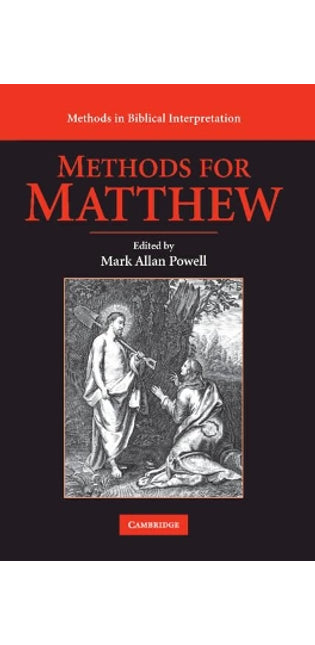
Methods for Matthew
Today's biblical scholars study the Gospel of Matthew with a wide variety of methods that yield diverse and exciting insights. Methods for Matthew offers a primer on six exegetical approaches that have proved to be especially useful and popular. In each case, a prominent scholar describes the principles and procedures of a particular approach and then demonstrates how that approach works in practice, applying it to a well-known text from Matthew's Gospel. As an added bonus, each of the chosen texts is treated to three different interpretations so that the reader can easily compare the results obtained through one approach to those obtained through other approaches. The reader will learn a great deal about two stories from Matthew ('the healing of a centurion's servant' and 'the resurrection of Jesus') and the reader will also learn enough about each of these six approaches to understand their function in biblical studies today.
R 3,533.00
R 366.00
R 348.00
R 629.00
R 1,082.00
R 233.00
R 349.00
R 831.00
R 664.00
R 889.00
R 366.00
Pursuit of Happiness and the American Regime
The Declaration of Independence claims that individuals need liberty to pursue happiness, but provides little guidance on the “what” of happiness. Happiness studies and liberal theory are incomplete guides. Happiness studies offer insights into what makes people happy but happiness policy risks becoming doctrinaire. Liberal theory is better on personal liberty, but weak on the “what” of happiness. My argument is that American novelists are surer guides on the pursuit of happiness. Treated as political thinkers, my book offers a close reading of four American novelists, Tom Wolfe, Walker Percy, Edith Wharton, and Nathaniel Hawthorne, and their critique of the pursuit of happiness. With a critical and friendly eye, they present the shortcomings of pursuing happiness in a liberal nation but also present alternatives and correctives possible in America. Our novelists point us toward each other in friendship as our greatest resource to guide us towards happiness.
R 3,456.00
R 1,296.00