


Search results for "9780241536278"
Items in stock - 4 working days delivery time

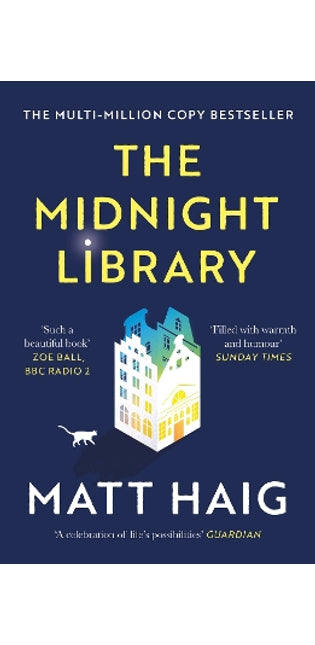
Midnight Library
THE SUNDAY TIMES NUMBER ONE BESTSELLING WORLDWIDE PHENOMENON READERS' MOST LOVED BOOK OF 2021WINNER OF THE GOODREADS CHOICE AWARD FOR FICTION'BEAUTIFUL' Jodi Picoult, 'UPLIFTING' i, 'BRILLIANT' Daily Mail, 'AMAZING' Joanna Cannon, 'ABSORBING' New York Times, 'THOUGHT-PROVOKING' IndependentNora's life has been going from bad to worse. Then at the stroke of midnight on her last day on earth she finds herself transported to a library. There she is given the chance to undo her regrets and try out each of the other lives she might have lived. Which raises the ultimate question: with infinite choices, what is the best way to live?
R 315.00
Items we need to order for you
R 348.00
R 565.00
R 830.00
Abundance
Annie Dillard has spent a lifetime examining the world around her with eyes wide open, drinking in all things intensely and relentlessly. Whether observing a sublime lunar eclipse or a moth consumed in a candle flame, the trembling of lily pads on a pond or hundreds of red-winged blackbirds taking flight, Dillard's awe at the fragility of the natural world rejuvenates and inspires pleasure and heartache. Precise in language and deeply meditative in spirit, this is a landmark collection from one of America's masters.
R 351.00
R 698.00
R 265.00
2034
An instant New York Times Bestseller! "Consider this another vaccine against disaster. Fortunately, this dose won't cause a temporary fever-and it happens to be a rippingly good read." -Wired "This crisply written and well-paced book reads like an all-caps warning for a world shackled to the machines we carry in our pockets and place on our laps . . ." -The Washington Post From two former military officers and award-winning authors, a chillingly authentic geopolitical thriller that imagines a naval clash between the US and China in the South China Sea in 2034-and the path from there to a nightmarish global conflagration. On March 12, 2034, US Navy Commodore Sarah Hunt is on the bridge of her flagship, the guided missile destroyer USS John Paul Jones, conducting a routine freedom of navigation patrol in the South China Sea when her ship detects an unflagged trawler in clear distress, smoke billowing from its bridge. On that same day, US Marine aviator Major Chris "Wedge" Mitchell is flying an F35E Lightning over the Strait of Hormuz, testing a new stealth technology as he flirts with Iranian airspace. By the end of that day, Wedge will be an Iranian prisoner, and Sarah Hunt's destroyer will lie at the bottom of the sea, sunk by the Chinese Navy. Iran and China have clearly coordinated their moves, which involve the use of powerful new forms of cyber weaponry that render US ships and planes defenseless. In a single day, America's faith in its military's strategic pre-eminence is in tatters. A new, terrifying era is at hand. So begins a disturbingly plausible work of speculative fiction, co-authored by an award-winning novelist and decorated Marine veteran and the former commander of NATO, a legendary admiral who has spent much of his career strategically outmaneuvering America's most tenacious adversaries. Written with a powerful blend of geopolitical sophistication and human empathy, 2034 takes us inside the minds of a global cast of characters--Americans, Chinese, Iranians, Russians, Indians--as a series of arrogant miscalculations on all sides leads the world into an intensifying international storm. In the end, China and the United States will have paid a staggering cost, one that forever alters the global balance of power. Everything in 2034 is an imaginative extrapolation from present-day facts on the ground combined with the authors' years working at the highest and most classified levels of national security. Sometimes it takes a brilliant work of fiction to illuminate the most dire of warnings: 2034 is all too close at hand, and this cautionary tale presents the reader a dark yet possible future that we must do all we can to avoid.
R 419.00
R 334.00
Lockhart Plot
During the spring and summer of 1918, with World War I still undecided, British, French and American agents in Russia developed a breathtakingly audacious plan. Led by Robert Hamilton Bruce Lockhart, a dashing, cynical, urbane 30-year-old Scot, they conspired to overthrow Lenin's newly established Bolshevik regime, and to install one that would continue the war against Germany on the Eastern Front. Lockhart's confidante and chief support, with whom he engaged in apassionate love affair, was the mysterious, alluring Moura von Benkendorff, wife of a former aide-de-camp to the Tsar.The plotters' chief opponent was 'Iron Felix' Dzerzhinsky. He led the Cheka, 'Sword and Shield' of the Russian Revolution and forerunner of the KGB. Dzerzhinsky loved humanity - in the abstract. He believed socialism represented humanity's best hope. To preserve and protect it he would unleash unbounded terror.Revolutionary Russia provided the setting for the ensuing contest. In the back streets of Petrograd and Moscow, in rough gypsy cabarets, in glittering nightclubs, in cells beneath the Cheka's Lubianka prison, the protagonists engaged in a deadly game of wits for the highest possible stakes - not merely life and death, but the outcome of a world war and the nature of Russia's post-war regime.Confident of success, the conspirators set the date for an uprising, September 8, 1918, but the Cheka had penetrated their organization and pounced just beforehand. The Lockhart Plot could have been a turning point in world history. Instead, its failure has left us with one of the great 'what ifs?' of twentieth century history, which is why it has until now remained shrouded in mystery. But it was a plot on whose outcome rested both the fate of the Revolution and the future shape of worldhistory - and the story behind it is a thrilling one that continues to resonate in the early 21st century.
R 869.00
R 437.00
In Search of Dark Matter
Written for the educated non-scientist and scientist alike, it spans a variety of scientific disciplines, from observational astronomy to particle physics. Concepts that the reader will encounter along the way are at the cutting edge of scientific research. However the themes are explained in such a way that no prior understanding of science beyond a high school education is necessary.
R 1,164.00
R 466.00
Separation
'Do you know what they call someone who doesn't drink, by the way, the Irish...? A pioneer. Isn't that gas? A pioneer. Like you're discovering a new continent.'On a Friday night in Dublin, Stephen Hanrahan ushers a young female colleague in from the summer rain to what was once his marital home. He’s ready to work his magic. But Stephen's estranged wife and wayward daughter are about to crash back into his life, casting a history of repressed truths and painful secrets into the light.Set in the build-up to Ireland's historic divorce referendum of 1995, The Separation is an unsettling - and uproarious - journey into the dark heart of a disintegrating Dublin family.
R 560.00
R 697.00
Normativity and Agency
Christine M. Korsgaard has had a profound influence on moral philosophy over the past forty years. Through her writing and teaching she has developed a distinctive, rigorous, and historically informed way of thinking about ethics, agency, and the normative dimension of human life more generally. The twelve original essays in this volume are written in her honor on the occasion of her retirement from teaching. They engage questions that recur in her work: Why are weobligated to do what morality demands? What features of our nature make us subject to moral obligation? What does it mean to be autonomous and responsible for what we do? What do we owe to nonhuman animals? Contributors include Stephen Darwall, Kyla Ebels-Duggan, Barbara Herman, Richard Moran, JapaPallikkathayil, Faviola Rivera-Castro, T.M. Scanlon, Tamar Schapiro, Sharon Street, David Sussman, Sigrún Svavarsdóttir, and David Velleman. These essays shed light on Korsgaard's own views while staking out provocative new positions on the topics that feature centrally in her own work.
R 3,949.00
Justice and Responsibility—Sensitive Egalitarianism
This text explores the place to locate the cut between those inequalities for which it is fair to hold one responsible, and those for which it is not. The argument traces a thread of intellectual history, identifying a rejection of strong property rights which we inherit from Locke, and find in contemporary defenders of entitlements such as Nozick.
R 2,057.00
R 468.00
R 629.00
R 466.00
Literature After Globalization
Choice Outstanding Academic Title 2014Literature after Globalization offers a detailed study of recent literary and theoretical responses to technology, globalization, and national identity. Focusing on texts of the the 1990s and 2000s, particularly novels and other writing by Mark Danielewski, Hari Kunzru, Indra Sinha, and Neal Stephenson, it charts a departure from narratives of globalization which declare the collapse of national cultures, and it considers how national sovereignty has been reinvented and reasserted in the face of technology's transnational effects. Drawing upon recent theoretical responses to technology and culture (including work by Yochai Benkler, Manuel Castells, Gilles Deleuze, Jacques Derrida, N. Katherine Hayles, Paul Virilio, and McKenzie Wark) this book will explore how, in these novels, the notion of an inclusive globalization has been replaced by a sense of national globalism.
R 1,591.00
R 930.00
R 1,296.00
R 466.00
Understanding Wittgenstein, Understanding Modernism
In the last half-century Ludwig Wittgenstein's relevance beyond analytic philosophy, to continental philosophy, to cultural studies, and to the arts has been widely acknowledged. Wittgenstein’s Tractatus Logico-Philosophicus was published in 1922 — the annus mirabilis of modernism — alongside Joyce’s Ulysses, Eliot’s The Waste Land, Mansfield’s The Garden Party and Woolf’s Jacob’s Room. Bertolt Brecht’s first play to be produced, Drums in the Night, was first staged in 1922, as was Jean Cocteau’s Antigone, with settings by Pablo Picasso and music by Arthur Honegger. In different ways, all these modernist landmarks dealt with the crisis of representation and the demise of eternal metaphysical and ethical truths. Wittgenstein’s Tractatus can be read as defining, expressing and reacting to this crisis. In his later philosophy, Wittgenstein adopted a novel philosophical attitude, sensitive to the ordinary uses of language as well as to the unnoticed dogmas they may betray. If the gist of modernism is self-reflection and attention to the way form expresses content, then Wittgenstein’s later ideas — in their fragmented form as well as their “ear-opening” contents — deliver it most precisely. Understanding Wittgenstein, Understanding Modernism shows Wittgenstein’s work, both early and late, to be closely linked to the modernist Geist that prevailed during his lifetime. Yet it would be wrong to argue that Wittgenstein was a modernist tout court. For Wittgenstein, as well as for modernist art, understanding is not gained by such straightforward statements. It needs time, hesitation, a variety of articulations, the refusal of tempting solutions, and perhaps even a sense of defeat. It is such a vision of the linkage between Wittgenstein and modernism that guides the present volume.
R 5,709.00
Books within Books
Books within Books presents some recent findings and research projects on the fragments of medieval Hebrew manuscripts discovered in the bindings of other manuscripts and early printed books across Europe. This is the second collection of interdisciplinary articles on Hebrew binding fragments presenting current scholarship and its international scope.From the contemporary perspective, the fragments of medieval Hebrew manuscripts preserved until today, through their numbers (estimated 30,000 fragments, so more than double of the number of the known Hebrew volumes produced in medieval Europe ), the texts they carry (some of them have been previously unknown), the insights into book making techniques and finally their economic impact, are an unprecedented source for our knowledge of the Hebrew book culture and literacy as well as the economic and intellectual exchanges between the Jewish minority and their non-Jewish neighbours.
R 8,884.00
Thatcher
This book is not a biography of Margaret Thatcher. It is a study of how her reputation in both the domestic and international sphere was constructed by Thatcher and others over the course of her career. Notably, this is the first scholarly treatment to make full use of the Thatcher Archive, and as a result has comprehensively reassessed and re-evaluated her place in the British political pantheon
R 1,351.00
Automata Studies. (AM-34), Volume 34
The description for this book, Automata Studies. (AM-34), will be forthcoming.
R 4,541.00
R 632.00
R 798.00
R 531.00
R 931.00
Logics of War
The modern ethics of war is a field of disparate, competing voices based on often unexplored theological and metaphysical assumptions. Therese Feiler approaches them from the borderline area between systematics, philosophical theology and religious studies. With reference to G. W. F. Hegel's and like-minded thinkers' 'theo–logic' that negotiates Christ’s mediation and immanent dialectics, Feiler identifies the logic and problem of mediation as the core concern of political ethics. Feiler unites five representative authors from now disparate strands of contemporary just war ethics, testing whether they offer a meaningful possibility of mediation and subsequent reconciliation: a sovereign realist and a cosmopolitan idealist; a rationalist individualist, an idealist Christian ethicist, and finally, an evangelical theologian. Opening the just war debate for comparative critical engagement, Feiler creates a fascinating study that locates a “dynamic point” at which faithful, free political action can be wrestled from irony, tragedy, and melancholic inertia in the face of totalitarian suffocation.
R 1,351.00
R 897.00
R 349.00
R 2,428.00
R 1,151.00
R 1,163.00
R 953.00
Gateways to Dogmatics
Today the work of theology, or "dogmatics," is widely thought to be of little practical importance for ordinary Christians. This challenging introduction to the tradition and practice of Christiandogmatics shows why reasoning theologically is still decisive for the life of the church. Gerhard Sauter introduces readers to the various approaches to dogmatics and points out what is essential in a complete and meaningful Christian theology. He also argues convincingly that dogmatics is properly understood as a movement of rational thought and not simply as an old-fashioned presentation of Christian doctrine, thereby firmly establishing the necessity of dogmatics for communicating the essentials of the faith.
R 734.00
R 1,030.00
R 863.00
R 599.00
R 590.00
R 670.00